Words without Borders; The Home of International Literature

Words without Borders; The Home of International Literature
Mauritania- Movement and Stasis/ * Click above image to read on...

Tuesday, April 26, 2011

Let It Snow


My brother Ted, as a young boy, had this elaborate ritual of buying 45 rpm records at the end of most weeks.  After collecting money from the patrons on his paper route, he would put so much aside for his PSFS savings account, some aside to buy candy from Doc’s and hoagies from George’s and some to get him to the record store on 69th  Street to buy the 45 that everyone wanted. He would dress- gabardine pants and elaborately patterned polyester shirts- for these weekly sojourns to the music mecca up the hill.

Though my dad and his brothers were avid jazz lovers, listeners and collectors, it was Ted who brought into our home what was new and coveted.  He-this young boy- also opened our home and hearts to what was quirky and exquisite; he introduced us to Phoebe Snow and to his new practice of buying albums. I can vividly recall most of her album covers and all of the lives I had lived when I listened to her music.  She and Janis Ian and Carole King were the first poets I loved.

I saw Phoebe perform years ago, in Philadelphia, at the famed
Chestnut Street
Cabaret and her magic is still with me.

Here’s the link to Inspired Insanity; one of my favorites.
 http://www.myspace.com/phoebesnowmusic/music/songs/inspired-insanity-28599361

Wednesday, April 20, 2011

Tim Hetherington-Bearing Witness


Broad Street & the Old Executive Grounds ©Tim Hetherington


Wedding Parties at Centennial Pavilion ©Tim Hetherington


When I select a piece of literature- a poem, a short story, a lesson about commas- for my young students and my own children, I do so with the explicit goal of moving them  forward on their journey of learning about themselves and their world.   I am an ideologue with an agenda; with a passion for people to discover not my truth, but a truth about the underbelly of this fat, beautiful world.  And I am most humbled and stripped of all swagger by those who seek not only to discover something new and uncomfortable, but to also bear witness to humanity when it has fallen and crawled into darkness. I am equally awed by those who purposefully seeks to affirm any dignity left standing.  This is what photojournalist Tim Hetherington did and this is why his death today in Libya was met with much sadness.  

Listen to him and learn how he navigated our perilous place as one who bears witness for us.

Source: New York Times/ June 2, 2009

In Defense of Flowers
By Octavia McBride-Ahebee

When I smell the wind of an AK-47
before it sounds its name
before it travels in rounds of seconds
splintering the thoughts of sterile termites
pushing through the destiny of evil
in search of me

I run to hide in the voluminous fury of a jasmine shrub in bloom
its pale butter blossoms shield me
from the bloodletting
bathing its roots

I snort, in silent gulps, which claim my dignity
the calming splendor of the jasmine’s bouquet

I am rescued
for an instance
from a hunter high
on the dizziness of his own deprivation

I am rescued
from my brother
by a performed bush

Tuesday, April 19, 2011

Yo-Yo Ma and Charles Riley-Now This is Poetry in Motion!


by Thoai Lu 

Celebrate Love
April 14, 2011

 An audience of over 100 grade school students at Los Angeles’s Inner City Arts got a big treat recently when world famous cellist Yo-Yo Ma teamed up with locally-based dancer Charles Riley for a rendition of “The Dying Swan.” In the performance, Ma uses his high-brow style of performance to provide the soundtrack for Riley’s style of interpretive urban dance. The two offered up their talents in order to highlight the need for more government-sponsored arts programs. You can see the whole thing in the video that’s above.
Ma, a Presidential Media of Freedom Award Recipient, is already world renowned. But LA-based Charles Riley, known by his stage name Lil’ Buck, is just starting to make a name on the national scene. The twenty-two-year old is the 2011 Vail International Dance Festival’s Artist-in-Residence and does a style of dance known as “jookin’”, which originated in his hometown of Memphis, Tennessee. He also taught the kids how a Michael Jackson-style moonwalk as Ma played Jackson’s “Billie Jean.”

“All the things that they talk about these days, with where our country is going — we need an innovative and knowledge work force,” Ma told Southern California Public Radio. “The best way to build innovation and creative imagination - and the most efficient way to do it - is actually by movement, visualizing, sound.”

“We can build community like nothing else,” Ma continued. “All it takes is imagination, attention and empathy — that we care.”

We’re ending the day as often as possible by celebrating love. We welcome your ideas for posts. Send suggestions to submissions@colorlines.com, and be sure to put Celebrate Love in the subject line. You can send links to videos, graphics, photos, quotes, whatever. Or just chime in to the comments below and we’ll find you. Be sure to let us know you’ve got the rights to share any media you send.

To see other Love posts visit our Celebrate Love page.

Tuesday, April 12, 2011

I Art Woodstock

This is the latest Visual Art video from Makulu Visual Arts. Shot and edited by Rowan Pybus it is an attempt to capture a slice of life in a corner of Woodstock in Cape Town while it was transformed through a massive mural campaign by some of the best street artists in South Africa.
 Here is a poem by Sri Chinmoy on the redemptive qualities of Art.

Art
By Sri Chinmoy

My Art is no art 
Without my mind's simplicity.

My Art does not want      
To subscribe to the view
That unhappiness
Commands the world.

When I paint or draw,
I keep my mind's thought-garden
Completely free of self-doubt-weeds.
  
My Art is the hide-and-seek      
Between my soul's illumining smiles    
And my heart's streaming tears.

The Artist in me has three  
Faithful, sleepless    
And self-giving friends:
A newness-eye, a oneness-heart
And a fulness-life.
  
The heart of my Art      
And the heart of a child
Are extremely fond of each other.
They love each other deeply;
They need each other constantly;
They are interdependent, sleeplessly.
 
My mind says that anything I do
Is too insignificant
Because I am wanting
In qualification.    
Needless to say,
This includes my Artwork.    
   
My heart says that anything I do
Is too significant
Because the God-Touch    
Is always there.
Needless to say,
This includes my Artwork.

The moment I start painting,  
I clearly see my soul-meditation
Is blessingfully clasping
My heart-aspiration-flames.
 
First things first: 
The Artist in me,
Before embarking on his Artwork,
Invariably catches
His heart's aspiration-express.
 
True, in my Art I want to see
The face of earth's beauty.
But I want to see
The heart of Heaven's Divinity    
More, infinitely more.


Wednesday, April 6, 2011

Siba N. Grovogui- How We Step into the World

Siba N. Grovogui of John Hopkins University

When my daughter was in middle school, she had a history project in which she had to create a poster presenting some aspect of the Renaissance Period. She produced a compelling piece entitled The Renaissance Through African Eyes. She depicted, through Renaissance paintings, the presence of Africans in Europe, but more importantly she illustrated the commercial link between Europe and Africa and how this trade contributed to funding Europe’s enlightenment. The teacher was a bit confused as were her peers, especially students of color. What did Africans have to do with the Renaissance? Did African people even exist then? Didn’t they just miraculously appear on the plantations of the New World just in time to harvest the crops?


This proclivity of marginalizing people and their place in world history is a hallmark of how history is delivered in American academic institutions. This is why I find Professor Siba N. Grovogui, of John Hopkins University, so refreshing and why his ideas need to be disseminated and considered. Like my daughter, he is West African-she from Cote d’Ivoire and he from Guinea, and I am so excited by both of their thoughtfulness.


Here is a video of Grovogui sharing some of his ideas. Have a listen and stretch your mind.


Saturday, April 2, 2011

Where My Birthmark Dances by Octavia McBride-Ahebee

My new poetry collection, Where My Birthmark Dances, is now available for purchase. This book is published by Finishing Line Press. The shipping date is July 23, 2011. Please support me now and buy my book. I will keep you informed of the book release party as well as my upcoming readings.  You may click here to purchase the book: http://www.finishinglinepress.com/NewReleasesandForthcomingTitles.htm

Lillian Dunn,editor of Apiary Journal, in describing this collection states:


             The Ancient Romans used to call a person's creative spirit her "genius," and recognized the labor of setting it free as one of love and sacrifice. Octavia McBride-Ahebee's latest collection is just such a labor. Her poems depict human longing, love and dignity in the context of global inequality with fierce, uncompromising grace. As her characters speak, she creates indelible sensory images of loveliness and affection, profound misery and anger, letting each co-exist on the page. The resulting complexity of tone makes space for nuanced and compelling human voices that might otherwise be categorized as  "victims" or "villains" of oppression. It takes the full use of genius to notice and capture these contradictions, and a deep social conscience to care so passionately about writing them down. This collection is one of McBride-Ahebee's "bighearted magnolia trees," its trunk scarred by the fire of sacrifice, its blossoms and branches so beautiful you don't want to leave their shade.


Wednesday, March 23, 2011

Toward A Secret Sky-Poetry at Giovanni's Room


Octavia McBride-Ahebee
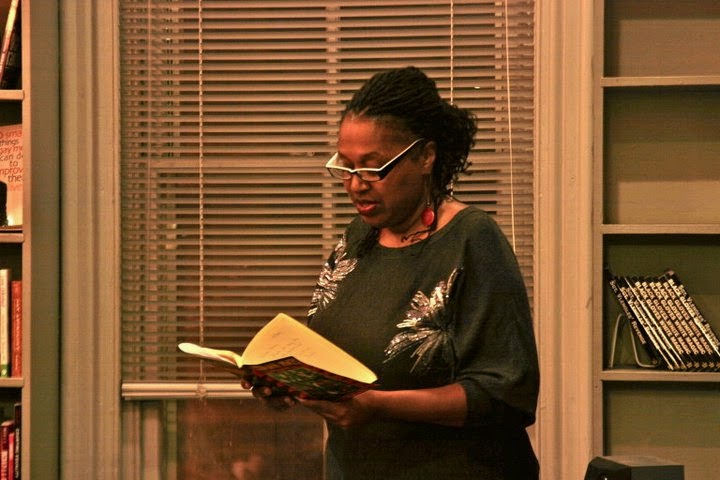
Last month, I read at the famed Giovanni’s Room along with some other fabulous poets.  This Light and Honey Reading Series was sponsored by Apiary.  Do look for my newest collection of poetry-Where My Birthmark Dances-which is due out in July and will be published by Finishing Line Press.


Warren Longmire


Rachna Vohra

J. Mase III


Apiary Literary Journal:  http://theapiarycorp.com/

These photos are from the Light and Honey event-Toward A Secret Sky.
  

Wednesday, August 25, 2010

Hello, America...My Name is Jimmy Baldwin


Even before I read Sonny’s Blues in my 9th grade English class with Mr. Ronald James, I had met James Baldwin many times before. Not in person, mind you, but his intellect, his passion and his uncompromising commitment to social justice were a palpable presence in my home and many others. There was a time, in the African-American community, regardless of class or level of formal education, when we knew our literary writers, our public philosophers and the platforms of our political leaders.

My father thought Baldwin’s short stories and novels conveyed too much anger. My mother, an avid collector of his essays, thought his tone, insight and activism brilliantly matched the monsters he battled. And my Aunt Sarah, an energetic theatre supporter, thought his plays were honest, dark, and, too often, underrated. Between the dissonance of everyday challenges, my home was filled with the glorious dissonance of words on a mission, of competing ideologies and of the faith placed in ideas and action. James Baldwin was, on many occasions, in the center of this.

I finally did reap the privilege of meeting James Baldwin, almost thirty years ago at Williams College. He not only met with the college community as a whole, but he met with a small group of African-American students as well. I literally sat, along with Dale and Herve, at his feet in Dodd House and I knew immediately I was in familiar company.

I cannot accurately capture the magnitude of James Baldwin’s genius. I can offer this suggestion, which is a grand one. Read his The Price of the Ticket; Collected NonFiction, 1948-1985 , which is filled with his singular, exacting analysis. You will appreciate, too, why he is, indeed, one of the world’s preeminent essayists.

Hello, America…My Name is Jimmy Baldwin is a play by Robert H. Miller that I will see tonight with my daughter and son. I am hoping Mr. Miller delivers on rendering just a glimmer of Baldwin’s magnificence to my children.


Hello, America…My Name is Jimmy Baldwin runs tonight at
The Moonstone Arts Center
110A S. 13 Street( on 13th, between Chestnut and Sansom Sts.)
Philadelphia, PA
215-735-9600
www.moonstoneartscenter.org

*Drawing by France Belleville


Monday, August 9, 2010

Cote d'Ivoire Turns 50-How Do We Celebrate ?

Cote d’Ivoire was my home for nine years. I married a wonderful man from there, had my babies there and lived a life where each moment was well spent. I share with you this article by Siddhartha Mitter because I like his take and tone in how he tries to convey the situation of Cote d’Ivoire today. Happy Birthday, Cote d’Ivoire !

Independence
By Siddhartha Mitter/Auguste 9, 2010
Source-Africa is a Country


By Paul Sika


“I’ve kept some distance from the 50th anniversary,” my friend says, “because I’m being doubted.” A few days ago he went online to check his voter eligibility status. My friend was born in Côte d’Ivoire and has always been Ivorian, nothing else. He travels back to Côte d’Ivoire for Christmas or, recently, to bury his parents, on his valid Ivorian passport. One would think this made him eligible to vote, but the voter rolls are the domain of a different agency. For more than a decade people from the north of the country, or whose last name suggests they might be from the north, have had trouble getting registered to vote. My friend is from the north. Several times in the past few years he has come to the consulate in New York armed with his passport, his old identity cards, various notarized statements, to make his case to the election officers who have deployed across the country and its diaspora. Now the file status gets posted online but the process behind it is as murky as ever. This time my friend found his name on the latest provisional voter list, subject to some unspecified further confirmation. This is better than last year, when his application was turned down. Being of a stubborn nature, my friend took the time to press his case. Many others didn’t bother.


Now Côte d’Ivoire is turning 50 — it became independent on August 7, 1960 — and my friend, whom any African would recognize as obviously Ivorian by accent, physiognomy, body language, tastes and sense of humor, doesn’t feel eager to celebrate. His friend Auguste has been pressing the gang to gather but it won’t be an independence party as much as a summer gathering of the old crew. Most of them have been in the United States for a decade or more, and with families and jobs and moves they don’t see each other as often as they’d like. Many are still in the northeast but others have moved to Atlanta, to big houses with dens and decks and finished basements in diverse suburbs with good schools. Some are Americans now, so the question of voting back home no longer applies. Among the crew, arguments about origins and national status briefly simmered ten years ago but never stuck. After the 2002 civil war left the country split in two, with a dysfunctional national unity government of southern loyalists and northern rebels, those with close ties back home positioned themselves as they saw fit, supporting one or another party or claiming indifference. Since the elections were due in 2005 but have been postponed over and over ever since, any differences of political opinion have long given way to the general lassitude. In Côte d’Ivoire the government loyalists and former rebels have gained so much material advantage from the status quo that both are happy to prolong the procedural farce that results in voter rolls that are never finalized and election logistics that are never quite ready. The two big opposition parties, which emerged from the old ruling party that oversaw Côte d’Ivoire’s prosperity in the 1970s, are on the outside looking in. My friend and his crew grew up in that old order, got good educations and started careers as engineers and accountants just as things were falling apart. They left before things got worse. Those who stay involved don’t let the politics get in their way, and certainly not alter their friendships.


Lately, many in the crew have been spending more time in Côte d’Ivoire, some to pursue opportunities in the fluid economic situation there, others because their US immigration status is resolved and they can travel back and forth without anxiety. While Abidjan celebrates independence, a bunch will get together in Bassam, the old colonial capital and beach town that is just an hour’s drive down a long seaside road through the coconut palms, lined with small resorts and outdoor bars with thatched cabanas. Bassam has become a gathering place for the crew ever since one of them, the one from New Jersey who cast his lot early on with the president’s party, landed a sinecure as head of a future free-trade zone in Bassam that no one seems actually interested in implementing. With an office and car and nice house and so little to do that he’s uncomfortable — he’s a finagler, but he’s not lazy — he has welcomed his friends for open-ended visits, a kind of decompression chamber between their American lives and the needs of their extended families in Abidjan and the village, the sick relatives and funerals and nephews and nieces who need school fees and uniforms and sponsorship for foreign universities, since the local one barely functions anymore. In Bassam they are taking care of each other as well. The one who lives in the South Bronx, in a grimy apartment in a building with fights outside and chicken bones strewn in the stairwell, has been camped out in Bassam for months. He’s Muslim and doesn’t drink, and he’s enlisted the others in long, daily power-walks on the beach, a group of men in their late forties getting fit American-style, startling the vendors and the prostitutes.


They’re in Bassam now, those ones and the one from Atlanta who hosted the big New Years’ bash, and the one who came all the way from Abidjan to that party and then nearly got killed in the Haiti earthquake when he went to visit friends in the Ivorian UN contingent there, and others too. They send my friend text messages. He’ll be with the northeastern crowd at Auguste and Christine’s — they’ve moved out of Mattapan and into one of the suburbs behind Quincy. They won’t ignore the 50th anniversary of independence, but they won’t really observe it, either. “The Dioula have this expression,” my friend says. “Ton dougou, c’est là où c’est bon pour toi. Wherever things are going well for you, that’s your village.”

Friday, July 30, 2010

What's Your Take On To Kill A Mockingbird ?


Last August, on the eve of the 50th anniversary of the publication of Harper Lee’s To Kill A Mockingbird, Malcolm Gladwell wrote an essay, for the New Yorker, about this iconic book. I’m amazed at how people’s take on the book/movie has changed over the years. I’m pleased to hear interpretations that are more complex and honest. I remember clearly reading this book almost 35 years ago, and knowing, both intuitively and experientially as an African-American female teen with a Southern mother who told many stories, that the premise of the book was dishonest and myopic.


Here is a link to Gladwell’s essay.
http://www.newyorker.com/reporting/2009/08/10/090810fa_fact_gladwell


And here is a response from my little brother, now a middle-aged man, to the movie version of To Kill a Mockingbird and his memories of his gut reaction to it, as a young black boy seeing it in the confines of his elite Main Line School.


I first saw this movie when I was at Waldron Academy. I was the only black person in the room. I've never liked this movie. Ever! I saw in it ,even then, everything that was wrong not just with movies, but with America in general. I told you long ago what was wrong with this film. The article touches on a lot of what I said. The novel itself could not follow it's own implications. Making the Boo Radley character the "Mockingbird" was a patent sellout. The obvious "Mockingbird" was Tom Robinson. The sheriff (and presumably everyone else in the country) does not mind having a dead black man on their conscience. But their sensibilities can't bear to have the sequestered life of the town recluse disturbed. "That would be like killing a mockingbird," says the son at the end of the film. They can't bend the racist protocols of their society to let an obviously innocent black man go free. But obstruction of justice is morally appropriate in the case of Boo Radleys all over America. America has been grounded in bullshit from the beginning; in politics; in business; in sports; in journalism; in everything. It is unrealistic to think that what passes for cinema in this country should be any different.

-J.M

*Drawing of  Mockingbird by Andrew Saeger